luminosity
 a few posts back, we learned that dow moved to paris to study at the academie julian under boulanger and lefebvre. what we learn today was that he was far from the only american painter to do exactly that exactly then. "The Académie Julian which was the largest and most important art school in Paris. Julian's fees were relatively modest and there were no preconditions or entrance requirements, consequently it attracted large numbers of foreigners from many nations -- Russians, Japanese, Brazilians, Britishers, and many Americans. 1
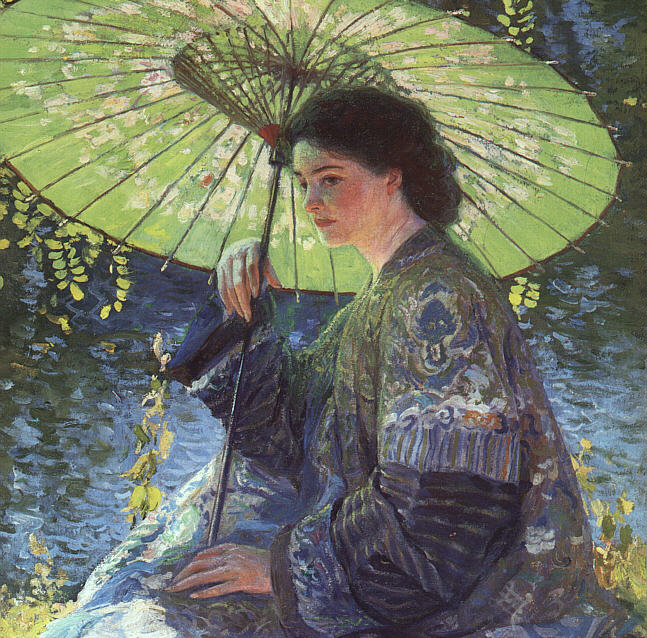
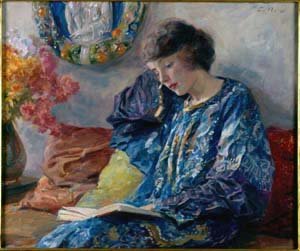
 following their studies, many americans travelled to the french village of giverny, forty miles northwest of paris, during these years, often meeting at Monet's home to paint, critique, and socialize. american impressionist Frederick Carl Frieseke settled in giverny along with painters Richard E. Miller, Metcalf Willard Leroy, John Twachtman, Childe Hassam, Robert William Vonnoh, Philip Leslie Hale, Thomas Wilmer Dewing, Guy Rose, Karl Albert Buehr, Louis Ritman, Lawton Silas Parker, and Edmund Greacen, Alson Skinner Clark, John Leslie Breck, Theodore Robinson, William Blair Bruce, Theodore Wende, Karl Anderson, and more.
 they were dubbed "the giverny luminists" or "giverny group," often exhibiting together, both in france and back in the US. they obviously painted together. sometimes at the same moment, and sometimes maybe at the same moment. the questions are endless -- are these (below) the same pool? both are surrounded by nasturtium.... are they at monet's house? looks like his house but i don't see that little circular pond anywhere....
 a group of painters, seeing with the same eyes, painting with the same brushes. sometimes many painting the one, say, boat, sometimes one painting the many... frieseke painted her endlessly, and there's no need to ask why, how lovely the scene is, repeating and repeating and repeating.
 studying about all of this, i began to wonder about something. dow was at the same school, at the same time, and followed the other artists (many of whom were infatuated with japanese prints) to giverny, and as they gravitated towards something of the same style, he came home dejected, and it wasn't until several years later that he "discovered" hokusai's prints in a book at the library. Why?
(to be continued)
Labels: childe hassam, detective, frederick frieseke, guy rose, karl albert buehr, lawton silas parker, richard miller
posted by lotusgreen at 5:46 PM
8 comments